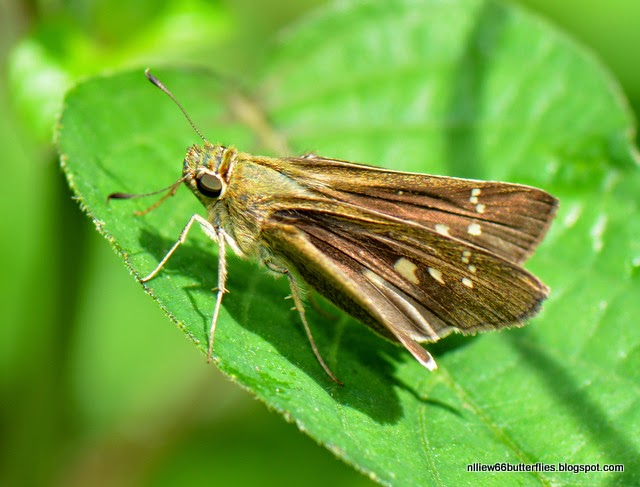
This was once a locally common species in Fraser's Hills but now is scarce due to habitat lost and use of herbicides on park and road management. However, in the Cameron Highlands (extra-Raub), it is still locally common where the host plant is found in abundance on fringes of parks and vegetable farms.
This tiny butterfly is a sun-worshipper (incidently its genus name "Helios" refers to the sun) and is best observed in the early hours when they sun themselves on low bushes. The host plant is a montane polygonaceae of the genus Persicaria found commonly in hill stations (pix below).


At lower mid-elevation, another species of host plant of the same family can be found on open moist river banks and a surprise capture of a specimen was made on this plant at 437m above sea level on the Main Range!


This tiny butterfly is a sun-worshipper (incidently its genus name "Helios" refers to the sun) and is best observed in the early hours when they sun themselves on low bushes. The host plant is a montane polygonaceae of the genus Persicaria found commonly in hill stations (pix below).
At lower mid-elevation, another species of host plant of the same family can be found on open moist river banks and a surprise capture of a specimen was made on this plant at 437m above sea level on the Main Range!


Habitat indicator
RSP
|
WV
|
PG
|
VF
|
FTR
|
SC
|
LWDF
|
LWPF
|
LMEF
|
UMN
|
MN
|
x
|
x
|
x
|
Frequency observation chart: (S marks the usual
occurences, H marks an unusually high occurence, F for first record)
2014
|
2015
|
||||||||||||
Nov
|
Dec
|
Jan
|
Feb
|
Mac
|
Apr
|
May
|
June
|
Jul
|
Aug
|
Sep
|
Oct
|
Nov
|
Dec
|
S8
|
S5
|
||||||||||||
2016
|
|||||||||||
Jan
|
Feb
|
Mac
|
Apr
|
May
|
Jun
|
Jul
|
Aug
|
Sep
|
Oct
|
Nov
|
Dec
|
S8,S16, S20
|
|||||||||||
2017
|
|||||||||||
Jan
|
Feb
|
Mac
|
Apr
|
May
|
Jun
|
Jul
|
Aug
|
Sep
|
Oct
|
Nov
|
Dec
|
S20
|
S20
|
S5S16
|
S5
|
S16
|
S19
|
||||||
2018
|
|||||||||||
Jan
|
Feb
|
Mac
|
Apr
|
May
|
Jun
|
Jul
|
Aug
|
Sep
|
Oct
|
Nov
|
Dec
|
S
|
S
|
S
|
S
|
S
|
S
|
S
|
S
|
S
|
S
|
||

15:10

15:22
Uppersides of a male (the shining purple patch on the basal areas of the wings not evident due to light angle)

15:57
The female lack the purple patch on the basal area of the wings and has much wider orange markings on both wings.

A male: 15:16. They are territorial and engage in aerial dogfights to get the best perch while sunning.

15:39

15:16

15:49
* * * * *

15:56

15:56
Above all photos from 03 May 2015
* * * * *


 Above photos of a newly eclosed female: 17 June 2015 @ 14:30 at S5
* * * * *
 13:43
 13:44
 13:46
Above pictures of a male and female from lower mid elevation exposed stream. 11 Feb 2017
* * * * *


 Above pictures of a male from 28 June 2017 @ 9:58
 26 Dec 2017 @ 12:31
* * * * *
Life History of Heliophorus epicles tweediei


 Above pictures of the caterpillar 26 Dec 2016 (10mm)


 28 Dec 2016 @ 15mm


* * * * *


* * * * *


Above pictures of a male and female from lower mid elevation exposed stream. 11 Feb 2017
* * * * *


* * * * *
Life History of Heliophorus epicles tweediei


Probably a 2nd instar(6mm): 20 Dec 2016 @ 12:27. The caterpillar ressembles that of a Drupadia. It feeds on the underside of the young leaves, biting through but leaving a thin transparent film on the leaf.


Above pictures of the 3rd instar caterpillar (9mm) 24 Dec 2016


Final instar: 30 Dec 2016 - 15mm


Pre-pupa stage: 31 Dec 2016 @ 14mm
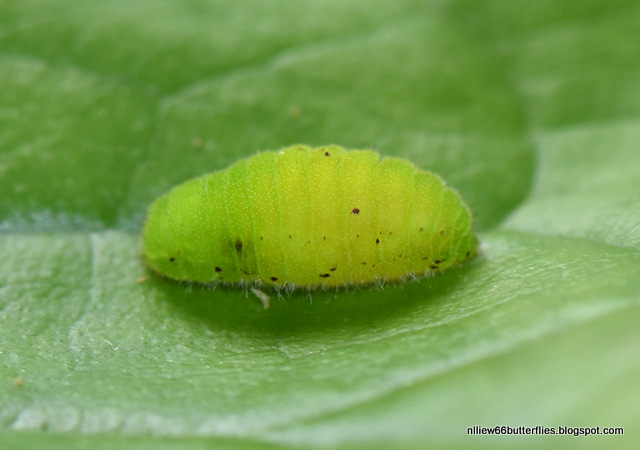
late pre-pupal stage

pupa

pre-eclosion: the pupa turning dark, showing the colours of the wings' uppersides

the newly eclosed imago
Consult the voucher collection from S8(bis) : http://nlliew66butterflies2.blogspot.com/2015/08/heliophorus-epicles-godart-1824.html